
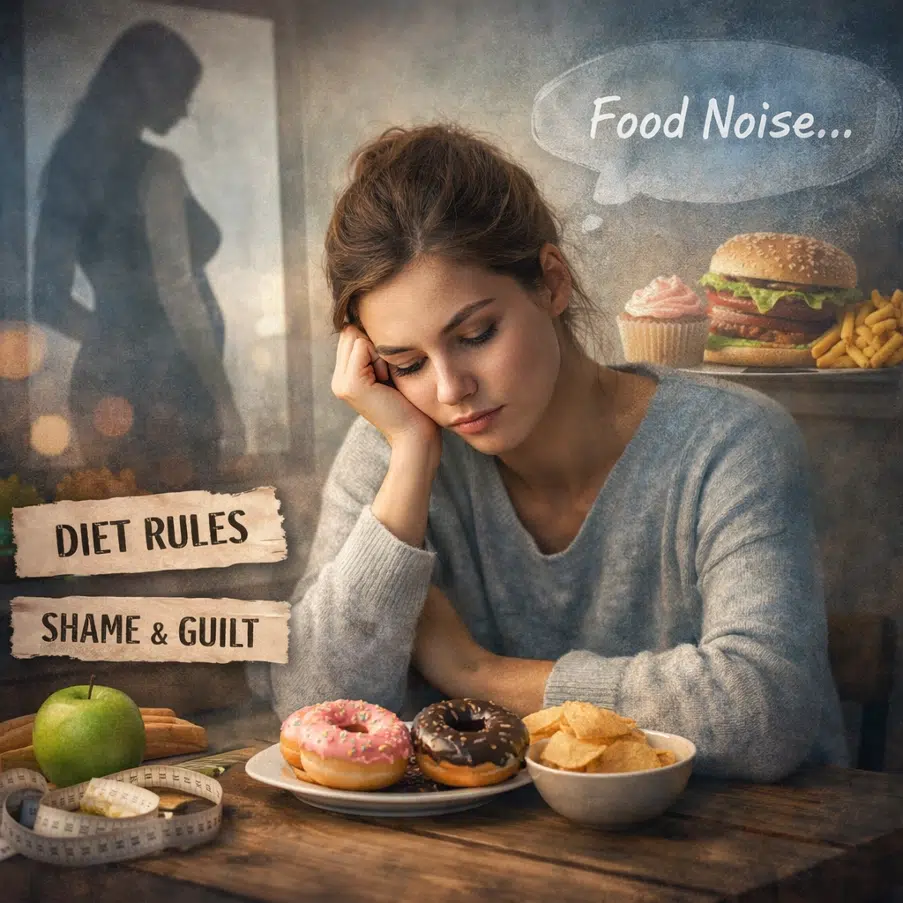
Many people struggle with food in ways that feel confusing or frustrating. You might find yourself constantly thinking about food, battling cravings, or feeling caught in cycles of dieting and overeating.
It can be easy to assume this is simply a matter of willpower. But in reality, disordered eating is rarely just about food.
Our relationship with food is shaped by our experiences, emotions, and the messages we receive from the world around us. When we begin to understand these deeper influences, it becomes much easier to approach food with compassion instead of blame.
Key takeaways
- Disordered eating is not the same as an eating disorder — many people experience difficult patterns around food without having a clinical diagnosis.
- The brain plays a central role — food can become part of the brain's emotional coping system, and this is a learned response, not a character flaw.
- Life experiences matter — how we see ourselves, our bodies, and our worth can profoundly shape our relationship with food.
- Change is possible — when the underlying emotional and neurological patterns are understood and addressed, a calmer relationship with food often follows.
What is disordered eating?
Disordered eating is a broad term used to describe unhealthy or stressful patterns around food and eating. It does not always mean someone has a clinical eating disorder.
Common signs of disordered eating include:
- Repeated cycles of dieting and overeating
- Feeling out of control around certain foods
- Constantly thinking about food or calories
- Feeling guilt, shame, or anxiety after eating
- Using food to manage emotions or stress
- Feeling that food dominates your thoughts

Many people live with these patterns for years without realising that there are understandable reasons behind them.
Emotional signs of stress
There is rarely a single cause. Instead, disordered eating usually develops through a combination of emotional experiences, brain learning, and social pressures.
Understanding these influences can help people move away from self-blame and toward meaningful change.
Emotional eating and the brain
The human brain is designed to protect us and restore a sense of safety when we feel distressed. Food can easily become part of that coping system.
For example, eating may:
- Temporarily reduce stress
- Provide comfort during difficult emotions
- Create a short burst of pleasure through dopamine release
- Distract from uncomfortable thoughts or feelings
Over time, the brain can learn to associate certain foods with emotional relief. This is often what people mean when they talk about emotional eating.
Importantly, this is not a failure of discipline. It is simply a learned response.
How life experiences can shape our relationship with food

Many people with disordered eating patterns have experienced moments in life that affected how they see themselves or their bodies.
These experiences may include:
- Bullying or teasing about weight or appearance
- Critical comments from family members or peers
- Unwanted attention about body shape
- Relationship difficulties or rejection
- Perfectionism or pressure to achieve
- Feeling "not good enough"
Even experiences that others might consider minor can leave strong emotional imprints on the brain.
Over time, these experiences can influence self-esteem, body image, and coping behaviours, including eating patterns.
The impact of diet culture
Modern society places enormous pressure on appearance and body size. From magazine covers to social media, we are constantly exposed to messages suggesting that thinner bodies are more successful, happier, or more attractive.
At the same time, the dieting industry promotes endless solutions promising rapid transformation.
This can create a powerful cycle:
The dieting cycle
- 1. A person starts a restrictive diet
- 2. The body reacts to restriction by increasing hunger and food focus
- 3. Eating increases or "control" slips
- 4. Shame and self-criticism appear
- 5. Another diet begins
Many people spend years trapped in this cycle of hope, restriction, guilt, and starting again.
Why dieting can increase food cravings
When the body experiences restriction, the brain can interpret this as a potential threat to survival. As a result, the brain may increase:
- Thoughts about food
- Cravings
- Urges to eat
- Sensitivity to rewarding foods
This biological response is one reason many people experience what is often called "food noise" — the feeling that food constantly occupies their thoughts.
This response is not a lack of willpower. It is simply how the brain protects the body.
Can disordered eating patterns change?
Yes. Many people are able to develop a calmer and more balanced relationship with food.
This often begins with a shift in perspective.
Instead of asking
"Why can't I control myself around food?"
Try asking
"What has my brain learned, and how can I help it feel safer?"
When people begin to address the emotional and neurological patterns beneath their eating habits, meaningful changes often follow.
Over time, many people notice that:
Food thoughts become quieter
Cravings lose their urgency
Eating feels more natural and relaxed
Guilt and shame around food begin to fade
A more compassionate way forward
Disordered eating is not a character flaw.
It is often the result of learned patterns shaped by life experiences, emotional needs, and cultural pressures.
When these patterns are approached with curiosity and compassion rather than judgement, the brain can begin to respond differently.
And for many people, this is where a calmer relationship with food begins.
If you would like support in changing your relationship with food, you may wish to explore The Dieting Mindset Rewrite™ — a structured programme designed to help people step out of the dieting cycle and develop a more peaceful approach to eating.